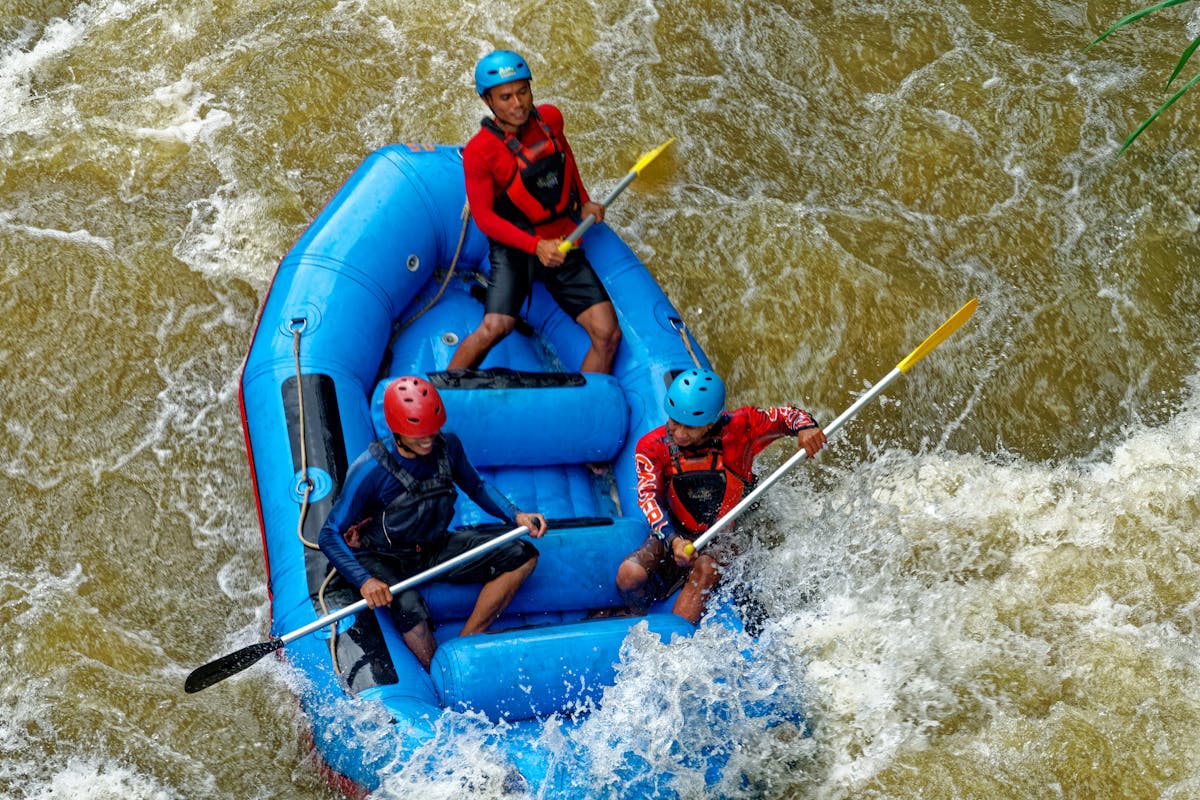
What Is Rafting?
White water rafting is an outdoor sport where a small team of people — typically 4 to 8 — paddles an inflatable raft down a river that contains rapids. A trained guide sits at the back of the raft, gives instructions, and steers using a paddle or oars. Everyone else paddles together to power the raft forward and respond to obstacles. It sounds intense, and the rapids themselves can be, but the basics are simple and anyone who can sit upright and follow instructions can do it.
Rafts are graded by river difficulty using the International Scale of River Difficulty, which runs from Class I (easy) to Class VI (extreme). Most commercial rafting around the world happens between Class II and Class IV. In Albania, our trips on the Vjosa and Osumi run between Class I and Class IV depending on the section and the season.
How a Typical Rafting Day Works
A rafting day usually starts in the morning with a meeting at our office or a hotel pickup. We drive to the put-in point — the place where rafts launch — which is typically 20 to 40 minutes away. At the put-in, you change into your wetsuit (we provide them), get your helmet and life jacket fitted, and listen to a 15-minute safety briefing where the guide explains paddle commands, what to do if you fall out, and how to behave during rapids.
Then you get into the raft and paddle. The trip itself usually takes between two and four hours of actual paddling time, depending on the route. There are usually one or two swimming stops where the guide pulls into a calm eddy and lets everyone jump out into the water. At the end, we take the rafts out of the river, drive back to the start, and you have lunch and head back to your hotel. The full day, door to door, is typically six to eight hours.
What to Wear and Bring
For the river itself, all you need is swimwear or quick-drying shorts and a top, plus water shoes or secure sandals. We provide the wetsuit, helmet, and life jacket. Bring a small towel and dry clothes for after, sunscreen, and water. Do not bring your phone, camera, or jewellery in the raft unless they are in a waterproof case — and even then we cannot guarantee they will survive. If you want photos, our guides take them for you. See our complete what-to-wear guide for full details.
Safety, Equipment and Guides
Modern rafts are self-bailing — they have drains in the floor so water that splashes in drains out automatically. The buoyancy of a properly inflated raft is enormous; it would take an exceptional event to flip one on the rivers we run. Life jackets are rated for white water, helmets are professional-grade, and our guides are certified by international rafting bodies. We carry first-aid kits, rescue throw bags, and on advanced trips a safety kayaker shadows the group.
All our guides have hundreds of trips of experience on the rivers we run. We do not put trainee guides in the back of a boat — they ride along as second crew until they have completed full certification. Read our safety article for an in-depth look at how we run safe trips.
Who Can Go Rafting?
Almost anyone in reasonable health and over the age of 7 can raft on the gentler sections of the Vjosa. Children 7-12 must be accompanied by a parent. For more challenging sections like Osumi or the Tepelene Vjosa, the minimum age is 10 or 14 depending on the route. There is no upper age limit — we have run guests in their seventies. If you have a heart condition, recent surgery, are pregnant, or have other medical concerns, talk to us first.
Booking Your First Trip
The simplest way to book is by WhatsApp. Send us your dates, group size, and a sentence about what kind of experience you want, and we will tell you which trip is the best fit. Booking takes about 10 minutes. We confirm with a 20% deposit; you pay the rest on the day. See our full booking guide for step-by-step instructions.
Frequently Asked Questions
What exactly is white water rafting?
White water rafting is a recreational outdoor activity where a team of paddlers navigates an inflatable raft down a river that contains rapids — sections of fast, turbulent water. A trained guide sits at the back of the raft and steers, while passengers paddle in coordination.
Is rafting safe?
Yes, when run by a licensed operator. Modern rafts are virtually unsinkable, every participant wears a helmet and a life jacket, and the guides are trained in swiftwater rescue. Statistically, commercial rafting has a lower injury rate than skiing or cycling.
Do I need to know how to swim?
We strongly recommend that you can swim, but you do not need to be a strong swimmer. The life jacket will keep you floating regardless. If you cannot swim at all, tell us in advance and we will put you on a calmer section of the river.
Ready to Try Rafting?
Book Your First Rafting TripRead more: Beginners Guide, Safety, How to Book, or our homepage.