People ask us this every week, usually with a slightly embarrassed smile, as if they should already know. They shouldn't, and they don't need to. Here is the honest, no-jargon answer from someone who guides this every day.
Book Your First TripRafting means going down a river inside an inflatable raft, usually with a few other people, and almost always with a guide who steers from the back. That is it. The word does not technically require rapids or whitewater — you can "raft" a calm river — but in everyday use, when someone says "rafting" they almost always mean the version with rapids. That is what most companies sell. That is what most people sign up for. And that is what we run here on the Vjosa and Osumi.
If you wanted the dictionary version: rafting is the recreational or competitive activity of navigating a river in an inflatable boat, typically through sections of moving or whitewater. But that is the kind of definition that doesn't actually tell you anything. Let me try a more useful one.
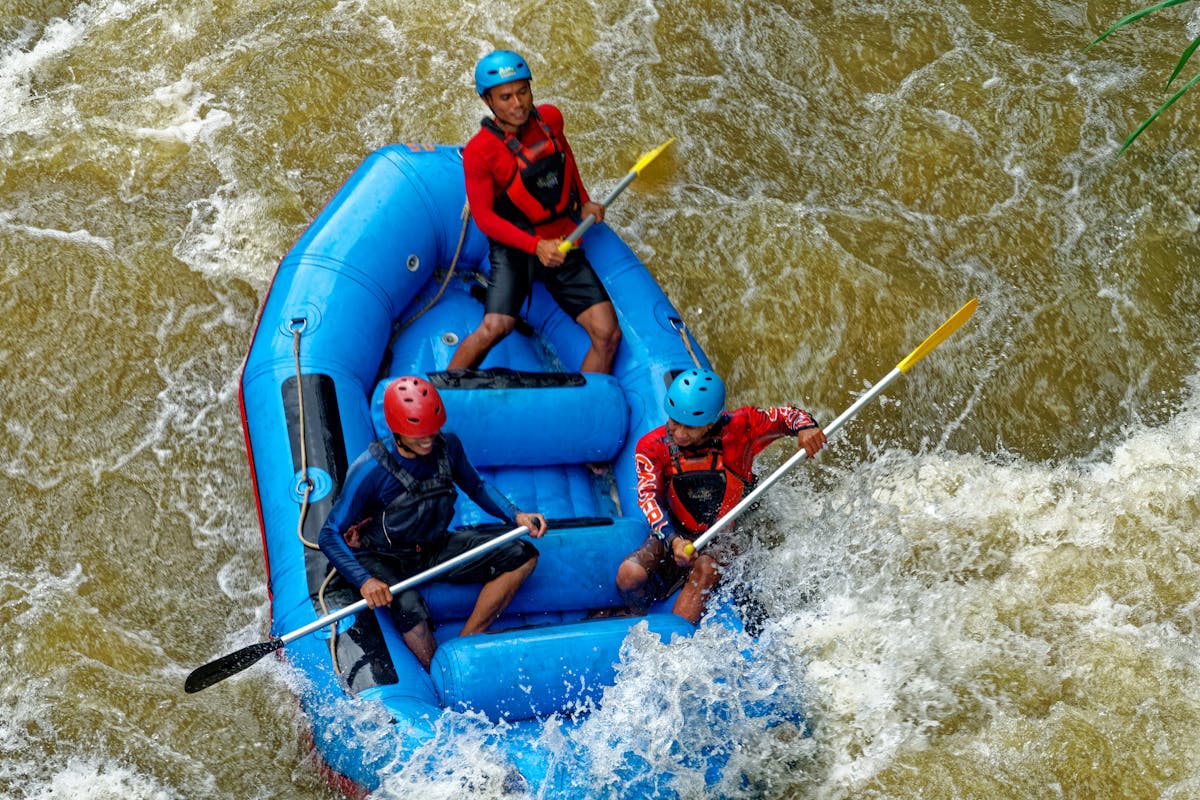
Imagine a large rubber boat — about three to four meters long, bright orange or yellow — sitting on the bank of a river. You and four or five other people put on helmets and life jackets. A guide hands you a paddle and shows you how to hold it. You climb in, sit on the inflated side tubes (not in the middle), and push off into the current.
For the next two to four hours, you paddle down the river. Sometimes the water is calm and you drift. Sometimes the river squeezes between rocks and turns into rapids, and the guide shouts "forward!" or "back!" and you all paddle hard. The boat bounces over waves. You get splashed. You laugh a lot. Occasionally you stop at a beach and someone jumps in to swim. At the end, you climb out, soaked and smiling, and you drive back to the start.
That is rafting. The word "rafting" is just shorthand for this entire experience.
This one surprised me when I looked it up years ago. The word "raft" goes back to Old Norse — raptr, meaning a beam or a log. For most of history, a raft was literally a platform of logs tied together with rope, used by people who could not afford boats or who needed to move heavy timber down a river. There are paintings from the 1600s showing peasants standing on log rafts in the Alps, ferrying themselves and their goods across rivers.
The activity we now call "rafting" — paying for a guided trip through whitewater in an inflatable boat — is much, much younger. It only really started in the United States in the 1970s, when surplus military rubber boats from the Korean War got repurposed for recreation on rivers like the Colorado and the Snake. Within a decade it had spread to the Alps, then to Eastern Europe, and finally to Albania in the 2000s. So when you raft on the Vjosa today, you are participating in an activity that is, in its modern form, only about fifty years old.
This is where things get slightly confusing. The word "rafting" covers several quite different activities, and it helps to know which one a company is actually offering before you book.
Commercial whitewater rafting. This is what 95% of tourist rafting is. A guide takes paying customers down a river with rapids that are challenging but not dangerous when properly managed. It is what we run. It is what you will find advertised in any tourist town near a river. Trip lengths vary from two-hour samplers to multi-day expeditions.
Recreational float trips. Same boat, same guide, but on a section of river without serious rapids. These are sometimes still called "rafting" but they are much closer to river tubing in terms of intensity. Good for families with very young children or for people who specifically do not want adrenaline.
Expedition rafting. Multi-day trips where you camp on the riverbank between paddling days. Common in places like the Grand Canyon, parts of Norway, and increasingly on the Vjosa.
Competitive rafting. Yes, it exists. The International Rafting Federation runs world championships every two years in disciplines like head-to-head racing, slalom, and downriver sprint. Albania has competed at this level since 2017, which was actually a meaningful moment for our local guide community.
Self-guided rafting. Some experienced paddlers run rivers without commercial guides. This is rare and not what most tourists do.
The confusion most beginners have is between rafting, kayaking, and tubing. Let me clear it up in one paragraph each.
Kayaking uses a small, closed boat that holds one person (sometimes two). You sit inside it, your legs are covered, you use a long double-bladed paddle, and you can roll the boat upright if it flips. It takes weeks or months to learn. It is much more athletic and technical than rafting.
River tubing uses a single inflated tube — basically a giant doughnut — that you sit inside while floating downstream. There is no paddle, no real steering, and no rapids beyond Class I. It is the most relaxed water activity that still involves a river. We run tubing trips on both the Vjosa and the Osumi.
Hydrospeed (sometimes called riverboarding) uses a single buoyant board you grip while wearing fins. You float face-down on the surface and use the fins to steer. It is the most intense way to go down a river. Our hydrospeed Vjosa tours are for people who want raw adrenaline.
Packrafting uses a tiny inflatable raft you carry in a backpack. You hike to a river, inflate the boat, paddle a section, deflate, and walk to the next put-in. It combines hiking and rafting in a single trip. Read about packrafting in Albania if it sounds interesting.
Of all these, classic rafting in a group raft is the one that requires the least skill and the least training. That is part of why it is so popular.
A surprising number of first-time guests show up expecting one of two things that the word does not actually cover. First, they expect a single boat with a motor — like a Zodiac on the sea. Rafting is not motorized. The boat moves because you and the rest of the team paddle it. Second, they expect an extreme sports experience, like cliff diving or canyon swinging. Commercial rafting is genuinely exciting but it is not extreme. The trips we sell are for ordinary people in ordinary fitness. We have run families with seven-year-olds and we have run grandparents in their seventies. The image of rafting as "extreme" comes from movies and YouTube videos, which tend to show only the dramatic moments.
The honest answer is: a guided trip down a river in an inflatable boat, with a small group, usually through some rapids, lasting two to four hours, requiring no skill but a willingness to paddle and follow instructions. Everything else is detail. You wear a helmet and a life jacket. The boat is virtually unsinkable. The guide does the steering. You contribute by paddling. At the end you are wet and happy and you have seen a river the way you cannot see it from any road.
If that sounds like something you want to try, we run it here on the Vjosa from April to October. Our main Vjosa page has all the details, or you can have a look at our full package list to compare what is on offer. If you want a deeper dive into how rafting actually works for first-timers, read our companion article everything about rafting.
Rafting means traveling down a river in an inflatable raft, usually with a small group of paddlers and a guide. In most modern usage, the word refers specifically to whitewater rafting — paddling through sections of a river that contain rapids — though it can also describe calmer river floats on the same kind of boat.
The word "raft" has Old Norse roots (raptr, meaning a beam or log) and originally referred to any flat floating platform made of tied-together timbers. Recreational rafting as we know it today emerged in the 1970s with the invention of modern inflatable boats, and the word has since narrowed to mean specifically that activity.
No. Rafting uses a large inflatable raft with several paddlers and a guide; kayaking uses a small one-person closed boat with a single paddler using a double-bladed paddle. Both navigate rivers, but the experience and skill required are very different. Rafting is much more accessible for beginners.
Rafting is both a recreational activity and a competitive sport. The World Rafting Federation organizes international championships in head-to-head, slalom, and downriver disciplines. For most people, however, rafting is simply a guided river adventure rather than a competitive pursuit.
Read more: Everything About Rafting, Beginners Guide, Vjosa River Tours, or our homepage.